💡 让我们以一个现实世界的例子来描述计算机中的数组。

想象你在一个图书馆,这个图书馆里有很多书架,每个书架上都有一排排的书。每本书都有一个特定的位置,你可以通过书架的编号和书的位置找到它。


在计算机中,数组就像这个图书馆中的书架一样。它是一个存储相同类型数据元素的数据结构。每个数据元素都有一个唯一的索引或位置,通过这个索引,你可以访问或修改特定位置的数据元素。

在计算机内存中,数组的元素是依次存储的,就像书架上的书一样。这样,计算机可以通过简单的数学运算来计算出元素的内存地址,从而快速访问数组中的任何元素。


数组是一种有效存储和访问大量相似数据的方式,就像图书馆中的书架一样可以帮助你组织和查找大量书籍。

数组是一种线性数据结构,使用数组存放的数据不仅在逻辑上会排成一条线,在物理上也是连续存储。存储的这些数据元素具有相同的数据类型。
数组中的元素存储在连续的内存位置中,并由一个索引(也称为下标)引用。下标是一个用于标识数组中的元素位置的序号。

2.1.1 数组的声明

我们知道在使用变量之前要先进行声明,同样的我们在使用数组的时候也要提前进行声明。数组的声明是这样的:

  • 1
  • 2
  • 3
  • 4
  • 5
  • 6
  • 7
  • 8
  • 9
  • 10
  • 11
  • 12
  • 13
  • 14
  • 15
  • 16
  • 17
  • 18
  • 19
  • 20
  • 21
  • 22
  • 23
  • 24
  • 25
  • 26
  • 27
  • 28
  • 29
  • 30
  • 31
  • 32
  • 33
  • 34
  • 35

#include <stdio.h>

#include <stdlib.h>

#define ElemType int

#define size 6

ElemType name[size];

ElemType name[size];

// 例如

int array[6] = {2, 6, 0, 8, 5, 4};

void access () {

int array[6] = {2, 6, 0, 8, 5, 4};

printf("%d", array[0]); // 访问第一个元素【2】

printf("%d", array[4]); // 访问第 5 个元素【5】

printf("%d", array[5]); // 访问最后一个【4】

}

void change () {

int array[6] = {2, 6, 0, 8, 5, 4};

array[2] = 3;

}

// 数据类型

#define ElemType int

#define MAX_SIZE 10 // 定义最大长度

typedef struct {

ElemType data[MAX_SIZE]; // 用静态的

int length; // 顺序表的当前长度

} SqList; // 顺序表的类型定义

// 初始化顺序表

void InitList (SqList &L) {

L.length = 0; // 顺序表初始长度为 0

// 完整代码:https://totuma.cn
  • ElemType:是我们要存放的数组元素的类型,类型可以是int, float,,double, char,或者其他可以使用的数据类型;

  • name:是用来表示数组的,称为数组名

  • size:当前数组可以存放的最大数量

例如,int 类型是我们最常用的数据类型。
我们可以使用以下来定义一个大小为10,数组名为array的数组。

  • 1
  • 2
  • 3
  • 4
  • 5
  • 6
  • 7
  • 8
  • 9
  • 10
  • 11
  • 12
  • 13
  • 14
  • 15
  • 16
  • 17
  • 18
  • 19
  • 20
  • 21
  • 22
  • 23
  • 24
  • 25
  • 26
  • 27
  • 28
  • 29
  • 30
  • 31
  • 32
  • 33
  • 34
  • 35

#include <stdio.h>

#include <stdlib.h>

#define ElemType int

#define size 6

ElemType name[size];

ElemType name[size];

// 例如

int array[6] = {2, 6, 0, 8, 5, 4};

void access () {

int array[6] = {2, 6, 0, 8, 5, 4};

printf("%d", array[0]); // 访问第一个元素【2】

printf("%d", array[4]); // 访问第 5 个元素【5】

printf("%d", array[5]); // 访问最后一个【4】

}

void change () {

int array[6] = {2, 6, 0, 8, 5, 4};

array[2] = 3;

}

// 数据类型

#define ElemType int

#define MAX_SIZE 10 // 定义最大长度

typedef struct {

ElemType data[MAX_SIZE]; // 用静态的

int length; // 顺序表的当前长度

} SqList; // 顺序表的类型定义

// 初始化顺序表

void InitList (SqList &L) {

L.length = 0; // 顺序表初始长度为 0

// 完整代码:https://totuma.cn

❗ 注意:

在本文后续中提到的所有

  • 索引或下标 都是从 0 开始计数。

  • 位序或第几个 都是从 1 开始计数。

在C 或者 C++ 中,数组索引从零开始
第一个元素存储在array[0]中,第二个元素存储在array[1]中,以此类推。

因此,最后一个元素,即第6个元素,被存储在array[5]中。
在内存中,数组将如图所示进行存储。注意,方括号内写的0、1、2、3、4、5是下标。
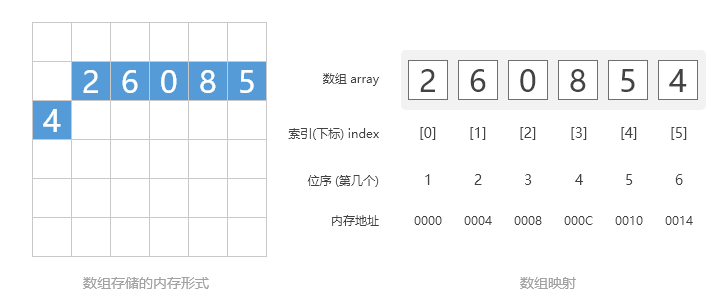
数组及内存结构

数组及内存结构

1 内存地址的计算

一个int类型的大小在内存中为4bytes。由于数组将其所有数据元素存储在连续的存储器位置中, 因此只需要知道数组首地址,即数组中第一个元素的地址就可以计算出该数组中其他元素的内存地址。
$$公式为:array[index] = base\_address + data\_type\_size \times index$$
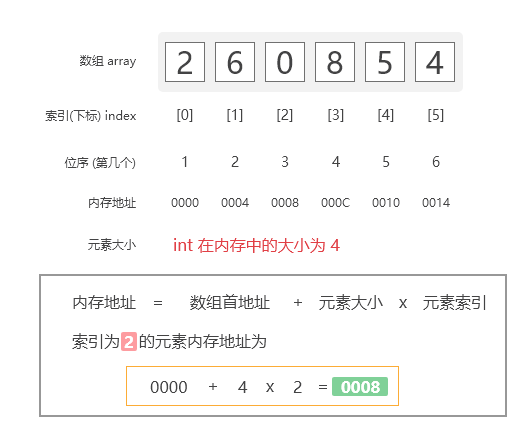
数组内存映射计算

数组内存映射计算

由于数组元素是连续存储在内存的中的,所以我们可以很方便的访问任意一个元素。
就像你在图书馆的书架上查找一本特定的书时,如果你知道它的编号或位置,你可以直接走到该位置,而不必按顺序检查每本书。

在数组中访问元素是非常高效的,可以在$O(1)$时间内随机访问数组中的任意一个元素

  • 1
  • 2
  • 3
  • 4
  • 5
  • 6
  • 7
  • 8
  • 9
  • 10
  • 11
  • 12
  • 13
  • 14
  • 15
  • 16
  • 17
  • 18
  • 19
  • 20
  • 21
  • 22
  • 23
  • 24
  • 25
  • 26
  • 27
  • 28
  • 29
  • 30
  • 31
  • 32
  • 33
  • 34
  • 35

#include <stdio.h>

#include <stdlib.h>

#define ElemType int

#define size 6

ElemType name[size];

ElemType name[size];

// 例如

int array[6] = {2, 6, 0, 8, 5, 4};

void access () {

int array[6] = {2, 6, 0, 8, 5, 4};

printf("%d", array[0]); // 访问第一个元素【2】

printf("%d", array[4]); // 访问第 5 个元素【5】

printf("%d", array[5]); // 访问最后一个【4】

}

void change () {

int array[6] = {2, 6, 0, 8, 5, 4};

array[2] = 3;

}

// 数据类型

#define ElemType int

#define MAX_SIZE 10 // 定义最大长度

typedef struct {

ElemType data[MAX_SIZE]; // 用静态的

int length; // 顺序表的当前长度

} SqList; // 顺序表的类型定义

// 初始化顺序表

void InitList (SqList &L) {

L.length = 0; // 顺序表初始长度为 0

// 完整代码:https://totuma.cn

在实际编码过程中,我们无需手动计算内存地址,因为每个元素占用大小相同的内存空间,数组元素的起始位置对于计算机也是已知的。 当我们在使用数组的下标来访问元素时,计算机可以通过上述的内存地址计算方法进行计算。

2 修改数组元素

需求:我们将index = 2第 3 个元素的值修改为3

操作步骤:

  • 先找到$array[2]$的内存地址,使用上述公式:

    $$\begin{split} array[2] &= base\_address + index \times data\_type\_size \\ \Rightarrow array[2] &= 0000 + 2 \times 4\\ \Rightarrow array[2] &= 0008 \end{split}$$

    注意上面是计算内存地址,不是赋值

  • 将内存地址为0xFFFF0008的值修改为3

代码实现比较简单,计算机已自动帮助我们计算内存地址,我们只需提供对应的索引(index)

  • 1
  • 2
  • 3
  • 4
  • 5
  • 6
  • 7
  • 8
  • 9
  • 10
  • 11
  • 12
  • 13
  • 14
  • 15
  • 16
  • 17
  • 18
  • 19
  • 20
  • 21
  • 22
  • 23
  • 24
  • 25
  • 26
  • 27
  • 28
  • 29
  • 30
  • 31
  • 32
  • 33
  • 34
  • 35

#include <stdio.h>

#include <stdlib.h>

#define ElemType int

#define size 6

ElemType name[size];

ElemType name[size];

// 例如

int array[6] = {2, 6, 0, 8, 5, 4};

void access () {

int array[6] = {2, 6, 0, 8, 5, 4};

printf("%d", array[0]); // 访问第一个元素【2】

printf("%d", array[4]); // 访问第 5 个元素【5】

printf("%d", array[5]); // 访问最后一个【4】

}

void change () {

int array[6] = {2, 6, 0, 8, 5, 4};

array[2] = 3;

}

// 数据类型

#define ElemType int

#define MAX_SIZE 10 // 定义最大长度

typedef struct {

ElemType data[MAX_SIZE]; // 用静态的

int length; // 顺序表的当前长度

} SqList; // 顺序表的类型定义

// 初始化顺序表

void InitList (SqList &L) {

L.length = 0; // 顺序表初始长度为 0

// 完整代码:https://totuma.cn

整个操作的时间复杂度为$O(1)$。

2.1.2 顺序表的介绍

💡 提示:

  • 数组是一种数据结构,用于存储相同类型的元素的集合。

  • 数组是一种顺序存储结构,元素在内存中按照一定的顺序依次存储。

那么数组和线性表的关系是什么呢?

  • 线性表是一种数据结构,其中元素排列成一条线一样的顺序。

  • 这种结构没有跳跃或分叉,每个元素都有且仅有一个前驱和一个后继。

  • 线性表包括顺序表(数组实现)和链表等。

数组是一种实现线性表的方式之一。线性表可以通过数组来实现,也可以通过链表等其他结构来实现。

因此,数组是线性表的一种实现方式,而线性表是一个更为抽象的概念,包括了多种实现方式,数组是其中之一。

通过数组实现的线性表称为顺序表。

1 顺序表的定义

线性表的顺序存储类型结构如下:

  • 1
  • 2
  • 3
  • 4
  • 5
  • 6
  • 7
  • 8
  • 9
  • 10
  • 11
  • 12
  • 13
  • 14
  • 15
  • 16
  • 17
  • 18
  • 19
  • 20
  • 21
  • 22
  • 23
  • 24
  • 25
  • 26
  • 27
  • 28
  • 29
  • 30
  • 31
  • 32
  • 33
  • 34
  • 35

#include <stdio.h>

#include <stdlib.h>

#define ElemType int

#define size 6

ElemType name[size];

ElemType name[size];

// 例如

int array[6] = {2, 6, 0, 8, 5, 4};

void access () {

int array[6] = {2, 6, 0, 8, 5, 4};

printf("%d", array[0]); // 访问第一个元素【2】

printf("%d", array[4]); // 访问第 5 个元素【5】

printf("%d", array[5]); // 访问最后一个【4】

}

void change () {

int array[6] = {2, 6, 0, 8, 5, 4};

array[2] = 3;

}

// 数据类型

#define ElemType int

#define MAX_SIZE 10 // 定义最大长度

typedef struct {

ElemType data[MAX_SIZE]; // 用静态的

int length; // 顺序表的当前长度

} SqList; // 顺序表的类型定义

// 初始化顺序表

void InitList (SqList &L) {

L.length = 0; // 顺序表初始长度为 0

// 完整代码:https://totuma.cn

定义了一个结构体SqList,包含两个成员变量:datalength

data 是一个静态数组,用于存储顺序表的元素,数组最多可以存储MAX_SIZE个元素;
length 用于记录顺序表的当前长度,即存储了多少个元素。

2 顺序表的初始化

  • 1
  • 2
  • 3
  • 4
  • 5
  • 6
  • 7
  • 8
  • 9
  • 10
  • 11
  • 12
  • 13
  • 14
  • 15
  • 16
  • 17
  • 18
  • 19
  • 20
  • 21
  • 22
  • 23
  • 24
  • 25
  • 26
  • 27
  • 28
  • 29
  • 30
  • 31
  • 32
  • 33
  • 34
  • 35

#include <stdio.h>

#include <stdlib.h>

#define ElemType int

#define size 6

ElemType name[size];

ElemType name[size];

// 例如

int array[6] = {2, 6, 0, 8, 5, 4};

void access () {

int array[6] = {2, 6, 0, 8, 5, 4};

printf("%d", array[0]); // 访问第一个元素【2】

printf("%d", array[4]); // 访问第 5 个元素【5】

printf("%d", array[5]); // 访问最后一个【4】

}

void change () {

int array[6] = {2, 6, 0, 8, 5, 4};

array[2] = 3;

}

// 数据类型

#define ElemType int

#define MAX_SIZE 10 // 定义最大长度

typedef struct {

ElemType data[MAX_SIZE]; // 用静态的

int length; // 顺序表的当前长度

} SqList; // 顺序表的类型定义

// 初始化顺序表

void InitList (SqList &L) {

L.length = 0; // 顺序表初始长度为 0

// 完整代码:https://totuma.cn

这个函数的作用是将传入的顺序表 L初始化为一个空表,长度为0。
在实际使用中,初始化是为了确保顺序表处于一个可控的状态,以便进行后续的插入、删除等操作。

2 在顺序表中插入元素

在顺序表中插入元素分为以下几种情况:

情况一:顺序表未满:插入在末尾

这种情况比较简单,我们只需要在当前最后一个元素的位置+1处直接赋值

例如:下面可视化窗口中的顺序表被声明为最大容量为10个元素,目前它存储了8个元素

步骤:

在末尾插入的位置为:9下标为:8 插入值5

继续在末尾位置插入值:10

顺序表未满:插入末尾 | 可视化完整可视化

2.1 Detailed Explanation of Sequential Lists - Linear Lists Tutorial Visualize your code with animations

图码-数据结构可视化动画版

Linear List: Sequential List (Array-Based Implementation)

Welcome to the comprehensive guide on the Sequential List (also known as the array-based linear list). This article is designed for data structure learners who want to understand the core principles, characteristics, and practical applications of this fundamental structure. We will also explore how our Data Structure & Algorithm Visualization Platform can help you master sequential lists through interactive animations and step-by-step demonstrations.

1. What is a Linear List?

A linear list is a finite sequence of data elements with the same data type. In a linear list, each element (except the first and last) has a unique predecessor and a unique successor. The logical relationship between elements is one-to-one, forming a linear ordering. The sequential list is the simplest and most intuitive way to store a linear list in computer memory.

2. Definition of Sequential List (Array-Based Implementation)

A sequential list stores all elements of a linear list in a contiguous block of memory, using an array as the underlying storage structure. Elements are placed one after another in consecutive memory addresses. The position of each element is determined by its index (starting from 0 or 1, depending on the language). This allows direct access to any element via its index in constant time O(1).

3. Key Characteristics of Sequential List

Understanding the properties of the sequential list is crucial for choosing the right data structure for your algorithm. Here are the most important characteristics:

  • Contiguous memory allocation: All elements are stored in adjacent memory cells. This improves cache locality and memory access speed.
  • Random access (direct access): Accessing the i-th element takes O(1) time, because the memory address can be calculated as: base_address + (i - 1) * element_size.
  • Fixed capacity (static array): In basic implementations, the size of the array is fixed at creation. Dynamic arrays (like Python list or Java ArrayList) can resize, but resizing is costly (O(n)).
  • Insertion and deletion are expensive: Inserting or deleting an element in the middle (or at the beginning) requires shifting all subsequent elements, resulting in O(n) time complexity on average.
  • Memory waste if underutilized: If the allocated array is much larger than the number of elements, memory is wasted. However, memory is compact and without fragmentation.

4. Basic Operations on Sequential List

Let's break down the fundamental operations with their time complexities. These operations are the building blocks for more complex algorithms.

4.1 Access (Search by Index)

As mentioned, accessing an element by its index is O(1). For example, list[2] directly returns the third element. This is the strongest advantage of sequential lists.

4.2 Search by Value

Finding a specific value requires a linear scan from the first element to the last (unless the list is sorted). The average time complexity is O(n). In the worst case, you examine all elements.

4.3 Insertion

Inserting a new element at the end of the list is O(1) if there is free space. However, inserting at the beginning or in the middle requires shifting all elements to the right. On average, insertion takes O(n) time. For dynamic arrays, resizing may also trigger O(n) copying.

4.4 Deletion

Deleting the last element is O(1). Deleting from the beginning or middle requires shifting elements to the left, resulting in O(n) average time. After deletion, unused array positions remain occupied (unless you shrink the array).

4.5 Traversal

Iterating over all elements is O(n). This is straightforward due to contiguous memory.

5. Advantages and Disadvantages of Sequential List

Every data structure has trade-offs. Here is a clear comparison:

Advantages

  • Fast random access (O(1)).
  • Memory locality improves cache performance.
  • Simple implementation and easy to understand.
  • No extra memory overhead for pointers (unlike linked lists).

Disadvantages

  • Insertion and deletion in the middle are slow (O(n)).
  • Fixed size (static array) leads to overflow or waste.
  • Resizing a dynamic array is expensive (O(n)).
  • Memory fragmentation is not an issue, but large contiguous blocks may be hard to allocate in memory-constrained environments.

6. Common Applications of Sequential List

Sequential lists are used everywhere in software development. Here are some typical scenarios:

  • Storing and accessing data by index: For example, a list of student IDs, temperature readings, or game leaderboards.
  • Implementing other data structures: Stacks and queues can be efficiently built using arrays (circular buffer for queue).
  • Buffer and cache implementations: Due to cache-friendly memory layout, arrays are used in audio/video buffers, ring buffers, etc.
  • Dynamic programming tables: Many DP algorithms use 2D arrays (sequential list of rows) for storing subproblem results.
  • Lookup tables and hash table buckets: Arrays provide O(1) access for hash table collision resolution (open addressing).

7. How Our Visualization Platform Helps You Master Sequential Lists

Our Data Structure & Algorithm Visualization Platform is built specifically for learners who want to see abstract concepts in action. For the sequential list, we provide the following features:

7.1 Interactive Animations

You can create a sequential list of any size, then perform insert, delete, search, and access operations. Each operation is animated step-by-step. For example, when you insert an element at index 2, you will see all elements from index 2 onward shift to the right one by one, highlighting the O(n) cost visually.

7.2 Code Synchronization

Each animation is synchronized with actual code (in Python, Java, C++, or JavaScript). You can see the code highlight as the animation progresses. This bridges the gap between visual understanding and actual implementation.

7.3 Time Complexity Display

After each operation, the platform displays the time complexity (e.g., "Insert at beginning: O(n)") and the actual number of steps performed. This reinforces the theoretical analysis with concrete examples.

7.4 Custom Test Cases

You can input your own data and operations. For instance, create a list of 100 elements and delete the first element 50 times. The platform will show you the cumulative effect and performance.

7.5 Comparison Mode

You can compare sequential list with linked list side-by-side. Perform the same sequence of operations on both structures and watch the difference in shifting vs. pointer updates. This helps you understand when each structure is better.

8. Step-by-Step Guide: Using the Visualization for Sequential List

Here is a practical walkthrough for a beginner:

  1. Open the platform and select "Linear List" from the menu, then choose "Sequential List (Array)".
  2. Initialize the list: Enter a size (e.g., 5) and fill with sample numbers like [10, 20, 30, 40, 50]. Click "Create".
  3. Access an element: Click "Access" and enter index 3. Watch the highlight jump directly to element 40. Note the O(1) performance.
  4. Insert an element: Click "Insert", choose index 1, and enter value 15. Observe how elements 20,30,40,50 shift right. The platform shows the shifting steps and counts them.
  5. Delete an element: Click "Delete", choose index 2. See elements shift left to fill the gap. The animation shows each shift.
  6. Search: Click "Search", enter value 30. The platform highlights each element checked until found. You can see the linear scan.
  7. Review the log: After each operation, the platform displays the current list state, the operation cost, and the code snippet. Use this to reinforce your learning.

9. Why Visualization is Critical for Learning Data Structures

Many students struggle with abstract concepts like pointer manipulation, shifting, and memory layout. Visualization transforms these concepts into concrete, observable actions. According to educational research, interactive visualizations improve retention and understanding by up to 60%. Our platform is designed with the following pedagogical principles:

  • Active learning: You control the operations, not just watch a video.
  • Immediate feedback: See the consequences of each action instantly.
  • Multi-modal representation: Visual + code + textual explanation.
  • Self-paced exploration: Experiment with extreme cases (empty list, full list, large data).

10. Sequential List vs. Linked List: When to Use Which?

One of the most common questions learners ask is: "Should I use an array or a linked list?" Our visualization platform includes a dedicated comparison tool. Here are the key guidelines:

  • Use sequential list (array) when: You need fast random access, the number of elements is known or changes slowly, and insertions/deletions are mostly at the end.
  • Use linked list when: You frequently insert or delete elements in the middle, the number of elements changes frequently, and you can tolerate slower access.

By running the same operations on both structures in our platform, you will intuitively understand these trade-offs.

11. Advanced Topics: Dynamic Arrays and Amortized Analysis

Our platform also covers advanced concepts like dynamic arrays (e.g., Python list, Java ArrayList). You can see the resizing process: when the array is full, a new larger array is allocated, and all elements are copied. The animation shows the copying step-by-step, and the platform explains amortized time complexity — how occasional O(n) resizing is balanced by many O(1) insertions, resulting in O(1) average cost per insertion.

12. Common Mistakes and How Visualization Helps Avoid Them

Beginners often make these errors:

  • Off-by-one errors: Forgetting that array indices start at 0. The platform highlights indices clearly.
  • Not shifting correctly during insertion: Overwriting elements instead of shifting. The animation shows the correct order (shift from right to left).
  • Forgetting to update length: The platform automatically tracks the logical size vs. capacity.
  • Assuming fast insertion at the beginning: The visual shows the heavy cost, making it memorable.

13. Performance Benchmarks (Visualized)

In the platform, you can run benchmarks: create a list of 10,000 elements, then perform 1,000 insertions at the beginning. The platform will plot a graph of time vs. number of operations. You will see a linear growth (O(n)) for each insertion, and the cumulative time grows quadratically. This is a powerful way to internalize complexity.

14. Integration with Other Data Structures

Sequential lists are the foundation for many other structures. Our platform shows how a stack can be implemented using an array (push/pop at the end), and how a queue can be implemented using a circular array. You can visualize the circular buffer and understand modulo arithmetic.

15. Conclusion: Master Sequential Lists with Visualization

The sequential list is the first step in understanding data structures. Its simplicity hides important concepts like memory layout, time complexity, and trade-offs. By using our Data Structure & Algorithm Visualization Platform, you can move from passive reading to active discovery. You will not only learn what a sequential list is, but also develop an intuition for when and why to use it.

Start exploring today: create a sequential list, perform operations, watch the animations, and read the synchronized code. In just a few hours, you will build a solid foundation for more complex structures like trees, graphs, and hash tables.

16. Frequently Asked Questions (FAQ)

Q: Is sequential list the same as an array?
A: In most programming languages, a sequential list is implemented using an array. But the term "sequential list" emphasizes the logical linear structure, while "array" is the physical storage. Our platform uses both terms interchangeably.

Q: How do I handle insertion at the end when the array is full?
A: In a static array, you cannot. In a dynamic array (like Python list), the platform shows the resizing process. You can also implement a "grow" strategy yourself.

Q: Why is shifting expensive?
A: Because each shift requires reading and writing a memory location. On a large list, this can be thousands of operations. The visualization shows each individual shift, making the cost tangible.

17. Ready to Learn?

Our platform is free for students and educators. We support multiple languages and provide instant feedback. Whether you are preparing for coding interviews or studying for a computer science exam, the sequential list module will give you a strong start. Click here to launch the interactive demo (link placeholder).

Remember: data structures are not just theoretical — they are tools you can see, touch, and manipulate. Let visualization be your guide.

Whether your goal is exam success, career development, or pure interest, this data structure and algorithm visualization website will be an invaluable resource.

Go to this website and start your learning journey!

图码 is a teaching platform dedicated to visualizing data structures and algorithms. This platform transforms abstract algorithm logic into intuitive visual processes through dynamic graphics, step-by-step animations, and interactive demonstrations, helping learners gain a deeper understanding of the operating mechanisms of various core algorithms, from basic sorting and tree structures to complex graph theory, dynamic programming, and more. Users can freely adjust the input data, control the execution rhythm, and observe the real-time state changes of each step of the algorithm, thus establishing a profound understanding of the essence of the algorithm through exploration. Originally designed for students of courses such as Data Structures and Algorithms in universities, 图码 has now developed into a widely used visual learning resource in the global computer education field. We believe that excellent educational tools should transcend geographical and classroom boundaries. TuCode adheres to the design concept of sharing and interaction, and is committed to providing a clear, flexible, and free visual learning experience for every algorithm learner around the world - whether they are university students, teachers, or self learners - allowing algorithm learning to be understood in sight and deepened in interaction.

情况二:顺序表已满:不能再插入元素

上面可视化动画在插入了两个元素以后,顺序表总共有10个元素,那么我们将不能再向它添加元素,这种情况我们是不能进行插入的。

情况三:顺序表未满:插入在中间

如果想要在顺序表中间插入一个元素,则需要将该元素之后的所有元素都向后移动一位,给要插入的元素腾出位置,之后再把元素赋值给该索引。

步骤:

当前顺序表中已有8个元素,我们在下标为5位序为6处插入值10

注意代码中 i 为位序,不是下标

数组未满:插入在中间 | 可视化完整可视化

2.1 Detailed Explanation of Sequential Lists - Linear Lists Tutorial Visualize your code with animations

图码-数据结构可视化动画版

Linear List: Sequential List (Array-Based Implementation)

Welcome to the comprehensive guide on the Sequential List (also known as the array-based linear list). This article is designed for data structure learners who want to understand the core principles, characteristics, and practical applications of this fundamental structure. We will also explore how our Data Structure & Algorithm Visualization Platform can help you master sequential lists through interactive animations and step-by-step demonstrations.

1. What is a Linear List?

A linear list is a finite sequence of data elements with the same data type. In a linear list, each element (except the first and last) has a unique predecessor and a unique successor. The logical relationship between elements is one-to-one, forming a linear ordering. The sequential list is the simplest and most intuitive way to store a linear list in computer memory.

2. Definition of Sequential List (Array-Based Implementation)

A sequential list stores all elements of a linear list in a contiguous block of memory, using an array as the underlying storage structure. Elements are placed one after another in consecutive memory addresses. The position of each element is determined by its index (starting from 0 or 1, depending on the language). This allows direct access to any element via its index in constant time O(1).

3. Key Characteristics of Sequential List

Understanding the properties of the sequential list is crucial for choosing the right data structure for your algorithm. Here are the most important characteristics:

  • Contiguous memory allocation: All elements are stored in adjacent memory cells. This improves cache locality and memory access speed.
  • Random access (direct access): Accessing the i-th element takes O(1) time, because the memory address can be calculated as: base_address + (i - 1) * element_size.
  • Fixed capacity (static array): In basic implementations, the size of the array is fixed at creation. Dynamic arrays (like Python list or Java ArrayList) can resize, but resizing is costly (O(n)).
  • Insertion and deletion are expensive: Inserting or deleting an element in the middle (or at the beginning) requires shifting all subsequent elements, resulting in O(n) time complexity on average.
  • Memory waste if underutilized: If the allocated array is much larger than the number of elements, memory is wasted. However, memory is compact and without fragmentation.

4. Basic Operations on Sequential List

Let's break down the fundamental operations with their time complexities. These operations are the building blocks for more complex algorithms.

4.1 Access (Search by Index)

As mentioned, accessing an element by its index is O(1). For example, list[2] directly returns the third element. This is the strongest advantage of sequential lists.

4.2 Search by Value

Finding a specific value requires a linear scan from the first element to the last (unless the list is sorted). The average time complexity is O(n). In the worst case, you examine all elements.

4.3 Insertion

Inserting a new element at the end of the list is O(1) if there is free space. However, inserting at the beginning or in the middle requires shifting all elements to the right. On average, insertion takes O(n) time. For dynamic arrays, resizing may also trigger O(n) copying.

4.4 Deletion

Deleting the last element is O(1). Deleting from the beginning or middle requires shifting elements to the left, resulting in O(n) average time. After deletion, unused array positions remain occupied (unless you shrink the array).

4.5 Traversal

Iterating over all elements is O(n). This is straightforward due to contiguous memory.

5. Advantages and Disadvantages of Sequential List

Every data structure has trade-offs. Here is a clear comparison:

Advantages

  • Fast random access (O(1)).
  • Memory locality improves cache performance.
  • Simple implementation and easy to understand.
  • No extra memory overhead for pointers (unlike linked lists).

Disadvantages

  • Insertion and deletion in the middle are slow (O(n)).
  • Fixed size (static array) leads to overflow or waste.
  • Resizing a dynamic array is expensive (O(n)).
  • Memory fragmentation is not an issue, but large contiguous blocks may be hard to allocate in memory-constrained environments.

6. Common Applications of Sequential List

Sequential lists are used everywhere in software development. Here are some typical scenarios:

  • Storing and accessing data by index: For example, a list of student IDs, temperature readings, or game leaderboards.
  • Implementing other data structures: Stacks and queues can be efficiently built using arrays (circular buffer for queue).
  • Buffer and cache implementations: Due to cache-friendly memory layout, arrays are used in audio/video buffers, ring buffers, etc.
  • Dynamic programming tables: Many DP algorithms use 2D arrays (sequential list of rows) for storing subproblem results.
  • Lookup tables and hash table buckets: Arrays provide O(1) access for hash table collision resolution (open addressing).

7. How Our Visualization Platform Helps You Master Sequential Lists

Our Data Structure & Algorithm Visualization Platform is built specifically for learners who want to see abstract concepts in action. For the sequential list, we provide the following features:

7.1 Interactive Animations

You can create a sequential list of any size, then perform insert, delete, search, and access operations. Each operation is animated step-by-step. For example, when you insert an element at index 2, you will see all elements from index 2 onward shift to the right one by one, highlighting the O(n) cost visually.

7.2 Code Synchronization

Each animation is synchronized with actual code (in Python, Java, C++, or JavaScript). You can see the code highlight as the animation progresses. This bridges the gap between visual understanding and actual implementation.

7.3 Time Complexity Display

After each operation, the platform displays the time complexity (e.g., "Insert at beginning: O(n)") and the actual number of steps performed. This reinforces the theoretical analysis with concrete examples.

7.4 Custom Test Cases

You can input your own data and operations. For instance, create a list of 100 elements and delete the first element 50 times. The platform will show you the cumulative effect and performance.

7.5 Comparison Mode

You can compare sequential list with linked list side-by-side. Perform the same sequence of operations on both structures and watch the difference in shifting vs. pointer updates. This helps you understand when each structure is better.

8. Step-by-Step Guide: Using the Visualization for Sequential List

Here is a practical walkthrough for a beginner:

  1. Open the platform and select "Linear List" from the menu, then choose "Sequential List (Array)".
  2. Initialize the list: Enter a size (e.g., 5) and fill with sample numbers like [10, 20, 30, 40, 50]. Click "Create".
  3. Access an element: Click "Access" and enter index 3. Watch the highlight jump directly to element 40. Note the O(1) performance.
  4. Insert an element: Click "Insert", choose index 1, and enter value 15. Observe how elements 20,30,40,50 shift right. The platform shows the shifting steps and counts them.
  5. Delete an element: Click "Delete", choose index 2. See elements shift left to fill the gap. The animation shows each shift.
  6. Search: Click "Search", enter value 30. The platform highlights each element checked until found. You can see the linear scan.
  7. Review the log: After each operation, the platform displays the current list state, the operation cost, and the code snippet. Use this to reinforce your learning.

9. Why Visualization is Critical for Learning Data Structures

Many students struggle with abstract concepts like pointer manipulation, shifting, and memory layout. Visualization transforms these concepts into concrete, observable actions. According to educational research, interactive visualizations improve retention and understanding by up to 60%. Our platform is designed with the following pedagogical principles:

  • Active learning: You control the operations, not just watch a video.
  • Immediate feedback: See the consequences of each action instantly.
  • Multi-modal representation: Visual + code + textual explanation.
  • Self-paced exploration: Experiment with extreme cases (empty list, full list, large data).

10. Sequential List vs. Linked List: When to Use Which?

One of the most common questions learners ask is: "Should I use an array or a linked list?" Our visualization platform includes a dedicated comparison tool. Here are the key guidelines:

  • Use sequential list (array) when: You need fast random access, the number of elements is known or changes slowly, and insertions/deletions are mostly at the end.
  • Use linked list when: You frequently insert or delete elements in the middle, the number of elements changes frequently, and you can tolerate slower access.

By running the same operations on both structures in our platform, you will intuitively understand these trade-offs.

11. Advanced Topics: Dynamic Arrays and Amortized Analysis

Our platform also covers advanced concepts like dynamic arrays (e.g., Python list, Java ArrayList). You can see the resizing process: when the array is full, a new larger array is allocated, and all elements are copied. The animation shows the copying step-by-step, and the platform explains amortized time complexity — how occasional O(n) resizing is balanced by many O(1) insertions, resulting in O(1) average cost per insertion.

12. Common Mistakes and How Visualization Helps Avoid Them

Beginners often make these errors:

  • Off-by-one errors: Forgetting that array indices start at 0. The platform highlights indices clearly.
  • Not shifting correctly during insertion: Overwriting elements instead of shifting. The animation shows the correct order (shift from right to left).
  • Forgetting to update length: The platform automatically tracks the logical size vs. capacity.
  • Assuming fast insertion at the beginning: The visual shows the heavy cost, making it memorable.

13. Performance Benchmarks (Visualized)

In the platform, you can run benchmarks: create a list of 10,000 elements, then perform 1,000 insertions at the beginning. The platform will plot a graph of time vs. number of operations. You will see a linear growth (O(n)) for each insertion, and the cumulative time grows quadratically. This is a powerful way to internalize complexity.

14. Integration with Other Data Structures

Sequential lists are the foundation for many other structures. Our platform shows how a stack can be implemented using an array (push/pop at the end), and how a queue can be implemented using a circular array. You can visualize the circular buffer and understand modulo arithmetic.

15. Conclusion: Master Sequential Lists with Visualization

The sequential list is the first step in understanding data structures. Its simplicity hides important concepts like memory layout, time complexity, and trade-offs. By using our Data Structure & Algorithm Visualization Platform, you can move from passive reading to active discovery. You will not only learn what a sequential list is, but also develop an intuition for when and why to use it.

Start exploring today: create a sequential list, perform operations, watch the animations, and read the synchronized code. In just a few hours, you will build a solid foundation for more complex structures like trees, graphs, and hash tables.

16. Frequently Asked Questions (FAQ)

Q: Is sequential list the same as an array?
A: In most programming languages, a sequential list is implemented using an array. But the term "sequential list" emphasizes the logical linear structure, while "array" is the physical storage. Our platform uses both terms interchangeably.

Q: How do I handle insertion at the end when the array is full?
A: In a static array, you cannot. In a dynamic array (like Python list), the platform shows the resizing process. You can also implement a "grow" strategy yourself.

Q: Why is shifting expensive?
A: Because each shift requires reading and writing a memory location. On a large list, this can be thousands of operations. The visualization shows each individual shift, making the cost tangible.

17. Ready to Learn?

Our platform is free for students and educators. We support multiple languages and provide instant feedback. Whether you are preparing for coding interviews or studying for a computer science exam, the sequential list module will give you a strong start. Click here to launch the interactive demo (link placeholder).

Remember: data structures are not just theoretical — they are tools you can see, touch, and manipulate. Let visualization be your guide.

Whether your goal is exam success, career development, or pure interest, this data structure and algorithm visualization website will be an invaluable resource.

Go to this website and start your learning journey!

图码 is a teaching platform dedicated to visualizing data structures and algorithms. This platform transforms abstract algorithm logic into intuitive visual processes through dynamic graphics, step-by-step animations, and interactive demonstrations, helping learners gain a deeper understanding of the operating mechanisms of various core algorithms, from basic sorting and tree structures to complex graph theory, dynamic programming, and more. Users can freely adjust the input data, control the execution rhythm, and observe the real-time state changes of each step of the algorithm, thus establishing a profound understanding of the essence of the algorithm through exploration. Originally designed for students of courses such as Data Structures and Algorithms in universities, 图码 has now developed into a widely used visual learning resource in the global computer education field. We believe that excellent educational tools should transcend geographical and classroom boundaries. TuCode adheres to the design concept of sharing and interaction, and is committed to providing a clear, flexible, and free visual learning experience for every algorithm learner around the world - whether they are university students, teachers, or self learners - allowing algorithm learning to be understood in sight and deepened in interaction.

时间复杂度:

  • 最好情况:如果插入操作发生在顺序表的末尾,并且顺序表有足够的空间,那么插入操作的时间复杂度为$O(1)$,即常数时间复杂度。这是因为直接在末尾添加元素不需要移动其他元素。

  • 最坏情况:如果插入操作发生在顺序表的开头,需要将所有元素向后移动一个位置。在最坏情况下,这个移动过程需要线性地遍历和移动$n$个元素,其中$n$是顺序表中的元素个数。因此,最坏情况下的时间复杂度为$O(n)$。

  • 平均情况: 平均情况下,需要移动插入位置后面一半的元素,因此平均时间复杂度为$O(\frac n 2)$,即$O(n)$。在大$O$表示法中,通常会忽略常数因子,因此平均时间复杂度仍然是$O(n)$。

4 删除顺序表中的元素

在一个顺序表中,如果我们要删除的元素位置在末尾,那么就非常简单。 我们只需要在当前存放元素的长度 -1 (L.length)
但是如果在其他位置进行删除我们要如何操作呢?

如果想要从顺序表中间位置删除一个元素,则需要将该元素之后的所有元素都向前移动一位,覆盖掉待删除的位置,同时保证顺序表的顺序结构。

步骤:

下面可视化面板中给出了最大容量为10的顺序表。
此时的顺序表内元素为{ 2, 6, 0, 8, 5, 4, 9, 8 },我们把下标为:3,位序为:4的元素删除掉。

❗ 注意:

删除元素完成后,原先末尾的元素变得无意义了,所以我们无须特意去修改它。

删除顺序表元素 | 可视化完整可视化

2.1 Detailed Explanation of Sequential Lists - Linear Lists Tutorial Visualize your code with animations

图码-数据结构可视化动画版

Linear List: Sequential List (Array-Based Implementation)

Welcome to the comprehensive guide on the Sequential List (also known as the array-based linear list). This article is designed for data structure learners who want to understand the core principles, characteristics, and practical applications of this fundamental structure. We will also explore how our Data Structure & Algorithm Visualization Platform can help you master sequential lists through interactive animations and step-by-step demonstrations.

1. What is a Linear List?

A linear list is a finite sequence of data elements with the same data type. In a linear list, each element (except the first and last) has a unique predecessor and a unique successor. The logical relationship between elements is one-to-one, forming a linear ordering. The sequential list is the simplest and most intuitive way to store a linear list in computer memory.

2. Definition of Sequential List (Array-Based Implementation)

A sequential list stores all elements of a linear list in a contiguous block of memory, using an array as the underlying storage structure. Elements are placed one after another in consecutive memory addresses. The position of each element is determined by its index (starting from 0 or 1, depending on the language). This allows direct access to any element via its index in constant time O(1).

3. Key Characteristics of Sequential List

Understanding the properties of the sequential list is crucial for choosing the right data structure for your algorithm. Here are the most important characteristics:

  • Contiguous memory allocation: All elements are stored in adjacent memory cells. This improves cache locality and memory access speed.
  • Random access (direct access): Accessing the i-th element takes O(1) time, because the memory address can be calculated as: base_address + (i - 1) * element_size.
  • Fixed capacity (static array): In basic implementations, the size of the array is fixed at creation. Dynamic arrays (like Python list or Java ArrayList) can resize, but resizing is costly (O(n)).
  • Insertion and deletion are expensive: Inserting or deleting an element in the middle (or at the beginning) requires shifting all subsequent elements, resulting in O(n) time complexity on average.
  • Memory waste if underutilized: If the allocated array is much larger than the number of elements, memory is wasted. However, memory is compact and without fragmentation.

4. Basic Operations on Sequential List

Let's break down the fundamental operations with their time complexities. These operations are the building blocks for more complex algorithms.

4.1 Access (Search by Index)

As mentioned, accessing an element by its index is O(1). For example, list[2] directly returns the third element. This is the strongest advantage of sequential lists.

4.2 Search by Value

Finding a specific value requires a linear scan from the first element to the last (unless the list is sorted). The average time complexity is O(n). In the worst case, you examine all elements.

4.3 Insertion

Inserting a new element at the end of the list is O(1) if there is free space. However, inserting at the beginning or in the middle requires shifting all elements to the right. On average, insertion takes O(n) time. For dynamic arrays, resizing may also trigger O(n) copying.

4.4 Deletion

Deleting the last element is O(1). Deleting from the beginning or middle requires shifting elements to the left, resulting in O(n) average time. After deletion, unused array positions remain occupied (unless you shrink the array).

4.5 Traversal

Iterating over all elements is O(n). This is straightforward due to contiguous memory.

5. Advantages and Disadvantages of Sequential List

Every data structure has trade-offs. Here is a clear comparison:

Advantages

  • Fast random access (O(1)).
  • Memory locality improves cache performance.
  • Simple implementation and easy to understand.
  • No extra memory overhead for pointers (unlike linked lists).

Disadvantages

  • Insertion and deletion in the middle are slow (O(n)).
  • Fixed size (static array) leads to overflow or waste.
  • Resizing a dynamic array is expensive (O(n)).
  • Memory fragmentation is not an issue, but large contiguous blocks may be hard to allocate in memory-constrained environments.

6. Common Applications of Sequential List

Sequential lists are used everywhere in software development. Here are some typical scenarios:

  • Storing and accessing data by index: For example, a list of student IDs, temperature readings, or game leaderboards.
  • Implementing other data structures: Stacks and queues can be efficiently built using arrays (circular buffer for queue).
  • Buffer and cache implementations: Due to cache-friendly memory layout, arrays are used in audio/video buffers, ring buffers, etc.
  • Dynamic programming tables: Many DP algorithms use 2D arrays (sequential list of rows) for storing subproblem results.
  • Lookup tables and hash table buckets: Arrays provide O(1) access for hash table collision resolution (open addressing).

7. How Our Visualization Platform Helps You Master Sequential Lists

Our Data Structure & Algorithm Visualization Platform is built specifically for learners who want to see abstract concepts in action. For the sequential list, we provide the following features:

7.1 Interactive Animations

You can create a sequential list of any size, then perform insert, delete, search, and access operations. Each operation is animated step-by-step. For example, when you insert an element at index 2, you will see all elements from index 2 onward shift to the right one by one, highlighting the O(n) cost visually.

7.2 Code Synchronization

Each animation is synchronized with actual code (in Python, Java, C++, or JavaScript). You can see the code highlight as the animation progresses. This bridges the gap between visual understanding and actual implementation.

7.3 Time Complexity Display

After each operation, the platform displays the time complexity (e.g., "Insert at beginning: O(n)") and the actual number of steps performed. This reinforces the theoretical analysis with concrete examples.

7.4 Custom Test Cases

You can input your own data and operations. For instance, create a list of 100 elements and delete the first element 50 times. The platform will show you the cumulative effect and performance.

7.5 Comparison Mode

You can compare sequential list with linked list side-by-side. Perform the same sequence of operations on both structures and watch the difference in shifting vs. pointer updates. This helps you understand when each structure is better.

8. Step-by-Step Guide: Using the Visualization for Sequential List

Here is a practical walkthrough for a beginner:

  1. Open the platform and select "Linear List" from the menu, then choose "Sequential List (Array)".
  2. Initialize the list: Enter a size (e.g., 5) and fill with sample numbers like [10, 20, 30, 40, 50]. Click "Create".
  3. Access an element: Click "Access" and enter index 3. Watch the highlight jump directly to element 40. Note the O(1) performance.
  4. Insert an element: Click "Insert", choose index 1, and enter value 15. Observe how elements 20,30,40,50 shift right. The platform shows the shifting steps and counts them.
  5. Delete an element: Click "Delete", choose index 2. See elements shift left to fill the gap. The animation shows each shift.
  6. Search: Click "Search", enter value 30. The platform highlights each element checked until found. You can see the linear scan.
  7. Review the log: After each operation, the platform displays the current list state, the operation cost, and the code snippet. Use this to reinforce your learning.

9. Why Visualization is Critical for Learning Data Structures

Many students struggle with abstract concepts like pointer manipulation, shifting, and memory layout. Visualization transforms these concepts into concrete, observable actions. According to educational research, interactive visualizations improve retention and understanding by up to 60%. Our platform is designed with the following pedagogical principles:

  • Active learning: You control the operations, not just watch a video.
  • Immediate feedback: See the consequences of each action instantly.
  • Multi-modal representation: Visual + code + textual explanation.
  • Self-paced exploration: Experiment with extreme cases (empty list, full list, large data).

10. Sequential List vs. Linked List: When to Use Which?

One of the most common questions learners ask is: "Should I use an array or a linked list?" Our visualization platform includes a dedicated comparison tool. Here are the key guidelines:

  • Use sequential list (array) when: You need fast random access, the number of elements is known or changes slowly, and insertions/deletions are mostly at the end.
  • Use linked list when: You frequently insert or delete elements in the middle, the number of elements changes frequently, and you can tolerate slower access.

By running the same operations on both structures in our platform, you will intuitively understand these trade-offs.

11. Advanced Topics: Dynamic Arrays and Amortized Analysis

Our platform also covers advanced concepts like dynamic arrays (e.g., Python list, Java ArrayList). You can see the resizing process: when the array is full, a new larger array is allocated, and all elements are copied. The animation shows the copying step-by-step, and the platform explains amortized time complexity — how occasional O(n) resizing is balanced by many O(1) insertions, resulting in O(1) average cost per insertion.

12. Common Mistakes and How Visualization Helps Avoid Them

Beginners often make these errors:

  • Off-by-one errors: Forgetting that array indices start at 0. The platform highlights indices clearly.
  • Not shifting correctly during insertion: Overwriting elements instead of shifting. The animation shows the correct order (shift from right to left).
  • Forgetting to update length: The platform automatically tracks the logical size vs. capacity.
  • Assuming fast insertion at the beginning: The visual shows the heavy cost, making it memorable.

13. Performance Benchmarks (Visualized)

In the platform, you can run benchmarks: create a list of 10,000 elements, then perform 1,000 insertions at the beginning. The platform will plot a graph of time vs. number of operations. You will see a linear growth (O(n)) for each insertion, and the cumulative time grows quadratically. This is a powerful way to internalize complexity.

14. Integration with Other Data Structures

Sequential lists are the foundation for many other structures. Our platform shows how a stack can be implemented using an array (push/pop at the end), and how a queue can be implemented using a circular array. You can visualize the circular buffer and understand modulo arithmetic.

15. Conclusion: Master Sequential Lists with Visualization

The sequential list is the first step in understanding data structures. Its simplicity hides important concepts like memory layout, time complexity, and trade-offs. By using our Data Structure & Algorithm Visualization Platform, you can move from passive reading to active discovery. You will not only learn what a sequential list is, but also develop an intuition for when and why to use it.

Start exploring today: create a sequential list, perform operations, watch the animations, and read the synchronized code. In just a few hours, you will build a solid foundation for more complex structures like trees, graphs, and hash tables.

16. Frequently Asked Questions (FAQ)

Q: Is sequential list the same as an array?
A: In most programming languages, a sequential list is implemented using an array. But the term "sequential list" emphasizes the logical linear structure, while "array" is the physical storage. Our platform uses both terms interchangeably.

Q: How do I handle insertion at the end when the array is full?
A: In a static array, you cannot. In a dynamic array (like Python list), the platform shows the resizing process. You can also implement a "grow" strategy yourself.

Q: Why is shifting expensive?
A: Because each shift requires reading and writing a memory location. On a large list, this can be thousands of operations. The visualization shows each individual shift, making the cost tangible.

17. Ready to Learn?

Our platform is free for students and educators. We support multiple languages and provide instant feedback. Whether you are preparing for coding interviews or studying for a computer science exam, the sequential list module will give you a strong start. Click here to launch the interactive demo (link placeholder).

Remember: data structures are not just theoretical — they are tools you can see, touch, and manipulate. Let visualization be your guide.

Whether your goal is exam success, career development, or pure interest, this data structure and algorithm visualization website will be an invaluable resource.

Go to this website and start your learning journey!

图码 is a teaching platform dedicated to visualizing data structures and algorithms. This platform transforms abstract algorithm logic into intuitive visual processes through dynamic graphics, step-by-step animations, and interactive demonstrations, helping learners gain a deeper understanding of the operating mechanisms of various core algorithms, from basic sorting and tree structures to complex graph theory, dynamic programming, and more. Users can freely adjust the input data, control the execution rhythm, and observe the real-time state changes of each step of the algorithm, thus establishing a profound understanding of the essence of the algorithm through exploration. Originally designed for students of courses such as Data Structures and Algorithms in universities, 图码 has now developed into a widely used visual learning resource in the global computer education field. We believe that excellent educational tools should transcend geographical and classroom boundaries. TuCode adheres to the design concept of sharing and interaction, and is committed to providing a clear, flexible, and free visual learning experience for every algorithm learner around the world - whether they are university students, teachers, or self learners - allowing algorithm learning to be understood in sight and deepened in interaction.

时间复杂度:

  • 最好情况:如果要删除的元素在顺序表的末尾,那么删除操作的时间复杂度为$O(1)$,即常数时间复杂度。这是因为直接删除末尾元素只需要将顺序表的长度减一即可,不需要移动其他元素。

  • 最差情况:如果要删除的元素在顺序表的开头,或者在中间,需要将被删除元素后面的所有元素向前移动一个位置。在最坏情况下,这个移动过程需要线性地遍历和移动$n$个元素,其中$n$是顺序表中的元素个数。因此,最坏情况下的时间复杂度为$O(n)$。

  • 平均情况:平均情况下,需要移动被删除元素后面一半的元素,因此平均时间复杂度为$O(\frac n 2)$,即$O(n)$。在大$O$表示法中,通常会忽略常数因子,因此平均时间复杂度仍然是$O(n)$。

5 查找顺序表的值-遍历

在顺序表中查找指定元素需要遍历顺序表,每轮判断顺序表值是否匹配,若匹配则通过e变量进行返回其位序

查找顺序表中的值 | 可视化完整可视化

2.1 Detailed Explanation of Sequential Lists - Linear Lists Tutorial Visualize your code with animations

图码-数据结构可视化动画版

Linear List: Sequential List (Array-Based Implementation)

Welcome to the comprehensive guide on the Sequential List (also known as the array-based linear list). This article is designed for data structure learners who want to understand the core principles, characteristics, and practical applications of this fundamental structure. We will also explore how our Data Structure & Algorithm Visualization Platform can help you master sequential lists through interactive animations and step-by-step demonstrations.

1. What is a Linear List?

A linear list is a finite sequence of data elements with the same data type. In a linear list, each element (except the first and last) has a unique predecessor and a unique successor. The logical relationship between elements is one-to-one, forming a linear ordering. The sequential list is the simplest and most intuitive way to store a linear list in computer memory.

2. Definition of Sequential List (Array-Based Implementation)

A sequential list stores all elements of a linear list in a contiguous block of memory, using an array as the underlying storage structure. Elements are placed one after another in consecutive memory addresses. The position of each element is determined by its index (starting from 0 or 1, depending on the language). This allows direct access to any element via its index in constant time O(1).

3. Key Characteristics of Sequential List

Understanding the properties of the sequential list is crucial for choosing the right data structure for your algorithm. Here are the most important characteristics:

  • Contiguous memory allocation: All elements are stored in adjacent memory cells. This improves cache locality and memory access speed.
  • Random access (direct access): Accessing the i-th element takes O(1) time, because the memory address can be calculated as: base_address + (i - 1) * element_size.
  • Fixed capacity (static array): In basic implementations, the size of the array is fixed at creation. Dynamic arrays (like Python list or Java ArrayList) can resize, but resizing is costly (O(n)).
  • Insertion and deletion are expensive: Inserting or deleting an element in the middle (or at the beginning) requires shifting all subsequent elements, resulting in O(n) time complexity on average.
  • Memory waste if underutilized: If the allocated array is much larger than the number of elements, memory is wasted. However, memory is compact and without fragmentation.

4. Basic Operations on Sequential List

Let's break down the fundamental operations with their time complexities. These operations are the building blocks for more complex algorithms.

4.1 Access (Search by Index)

As mentioned, accessing an element by its index is O(1). For example, list[2] directly returns the third element. This is the strongest advantage of sequential lists.

4.2 Search by Value

Finding a specific value requires a linear scan from the first element to the last (unless the list is sorted). The average time complexity is O(n). In the worst case, you examine all elements.

4.3 Insertion

Inserting a new element at the end of the list is O(1) if there is free space. However, inserting at the beginning or in the middle requires shifting all elements to the right. On average, insertion takes O(n) time. For dynamic arrays, resizing may also trigger O(n) copying.

4.4 Deletion

Deleting the last element is O(1). Deleting from the beginning or middle requires shifting elements to the left, resulting in O(n) average time. After deletion, unused array positions remain occupied (unless you shrink the array).

4.5 Traversal

Iterating over all elements is O(n). This is straightforward due to contiguous memory.

5. Advantages and Disadvantages of Sequential List

Every data structure has trade-offs. Here is a clear comparison:

Advantages

  • Fast random access (O(1)).
  • Memory locality improves cache performance.
  • Simple implementation and easy to understand.
  • No extra memory overhead for pointers (unlike linked lists).

Disadvantages

  • Insertion and deletion in the middle are slow (O(n)).
  • Fixed size (static array) leads to overflow or waste.
  • Resizing a dynamic array is expensive (O(n)).
  • Memory fragmentation is not an issue, but large contiguous blocks may be hard to allocate in memory-constrained environments.

6. Common Applications of Sequential List

Sequential lists are used everywhere in software development. Here are some typical scenarios:

  • Storing and accessing data by index: For example, a list of student IDs, temperature readings, or game leaderboards.
  • Implementing other data structures: Stacks and queues can be efficiently built using arrays (circular buffer for queue).
  • Buffer and cache implementations: Due to cache-friendly memory layout, arrays are used in audio/video buffers, ring buffers, etc.
  • Dynamic programming tables: Many DP algorithms use 2D arrays (sequential list of rows) for storing subproblem results.
  • Lookup tables and hash table buckets: Arrays provide O(1) access for hash table collision resolution (open addressing).

7. How Our Visualization Platform Helps You Master Sequential Lists

Our Data Structure & Algorithm Visualization Platform is built specifically for learners who want to see abstract concepts in action. For the sequential list, we provide the following features:

7.1 Interactive Animations

You can create a sequential list of any size, then perform insert, delete, search, and access operations. Each operation is animated step-by-step. For example, when you insert an element at index 2, you will see all elements from index 2 onward shift to the right one by one, highlighting the O(n) cost visually.

7.2 Code Synchronization

Each animation is synchronized with actual code (in Python, Java, C++, or JavaScript). You can see the code highlight as the animation progresses. This bridges the gap between visual understanding and actual implementation.

7.3 Time Complexity Display

After each operation, the platform displays the time complexity (e.g., "Insert at beginning: O(n)") and the actual number of steps performed. This reinforces the theoretical analysis with concrete examples.

7.4 Custom Test Cases

You can input your own data and operations. For instance, create a list of 100 elements and delete the first element 50 times. The platform will show you the cumulative effect and performance.

7.5 Comparison Mode

You can compare sequential list with linked list side-by-side. Perform the same sequence of operations on both structures and watch the difference in shifting vs. pointer updates. This helps you understand when each structure is better.

8. Step-by-Step Guide: Using the Visualization for Sequential List

Here is a practical walkthrough for a beginner:

  1. Open the platform and select "Linear List" from the menu, then choose "Sequential List (Array)".
  2. Initialize the list: Enter a size (e.g., 5) and fill with sample numbers like [10, 20, 30, 40, 50]. Click "Create".
  3. Access an element: Click "Access" and enter index 3. Watch the highlight jump directly to element 40. Note the O(1) performance.
  4. Insert an element: Click "Insert", choose index 1, and enter value 15. Observe how elements 20,30,40,50 shift right. The platform shows the shifting steps and counts them.
  5. Delete an element: Click "Delete", choose index 2. See elements shift left to fill the gap. The animation shows each shift.
  6. Search: Click "Search", enter value 30. The platform highlights each element checked until found. You can see the linear scan.
  7. Review the log: After each operation, the platform displays the current list state, the operation cost, and the code snippet. Use this to reinforce your learning.

9. Why Visualization is Critical for Learning Data Structures

Many students struggle with abstract concepts like pointer manipulation, shifting, and memory layout. Visualization transforms these concepts into concrete, observable actions. According to educational research, interactive visualizations improve retention and understanding by up to 60%. Our platform is designed with the following pedagogical principles:

  • Active learning: You control the operations, not just watch a video.
  • Immediate feedback: See the consequences of each action instantly.
  • Multi-modal representation: Visual + code + textual explanation.
  • Self-paced exploration: Experiment with extreme cases (empty list, full list, large data).

10. Sequential List vs. Linked List: When to Use Which?

One of the most common questions learners ask is: "Should I use an array or a linked list?" Our visualization platform includes a dedicated comparison tool. Here are the key guidelines:

  • Use sequential list (array) when: You need fast random access, the number of elements is known or changes slowly, and insertions/deletions are mostly at the end.
  • Use linked list when: You frequently insert or delete elements in the middle, the number of elements changes frequently, and you can tolerate slower access.

By running the same operations on both structures in our platform, you will intuitively understand these trade-offs.

11. Advanced Topics: Dynamic Arrays and Amortized Analysis

Our platform also covers advanced concepts like dynamic arrays (e.g., Python list, Java ArrayList). You can see the resizing process: when the array is full, a new larger array is allocated, and all elements are copied. The animation shows the copying step-by-step, and the platform explains amortized time complexity — how occasional O(n) resizing is balanced by many O(1) insertions, resulting in O(1) average cost per insertion.

12. Common Mistakes and How Visualization Helps Avoid Them

Beginners often make these errors:

  • Off-by-one errors: Forgetting that array indices start at 0. The platform highlights indices clearly.
  • Not shifting correctly during insertion: Overwriting elements instead of shifting. The animation shows the correct order (shift from right to left).
  • Forgetting to update length: The platform automatically tracks the logical size vs. capacity.
  • Assuming fast insertion at the beginning: The visual shows the heavy cost, making it memorable.

13. Performance Benchmarks (Visualized)

In the platform, you can run benchmarks: create a list of 10,000 elements, then perform 1,000 insertions at the beginning. The platform will plot a graph of time vs. number of operations. You will see a linear growth (O(n)) for each insertion, and the cumulative time grows quadratically. This is a powerful way to internalize complexity.

14. Integration with Other Data Structures

Sequential lists are the foundation for many other structures. Our platform shows how a stack can be implemented using an array (push/pop at the end), and how a queue can be implemented using a circular array. You can visualize the circular buffer and understand modulo arithmetic.

15. Conclusion: Master Sequential Lists with Visualization

The sequential list is the first step in understanding data structures. Its simplicity hides important concepts like memory layout, time complexity, and trade-offs. By using our Data Structure & Algorithm Visualization Platform, you can move from passive reading to active discovery. You will not only learn what a sequential list is, but also develop an intuition for when and why to use it.

Start exploring today: create a sequential list, perform operations, watch the animations, and read the synchronized code. In just a few hours, you will build a solid foundation for more complex structures like trees, graphs, and hash tables.

16. Frequently Asked Questions (FAQ)

Q: Is sequential list the same as an array?
A: In most programming languages, a sequential list is implemented using an array. But the term "sequential list" emphasizes the logical linear structure, while "array" is the physical storage. Our platform uses both terms interchangeably.

Q: How do I handle insertion at the end when the array is full?
A: In a static array, you cannot. In a dynamic array (like Python list), the platform shows the resizing process. You can also implement a "grow" strategy yourself.

Q: Why is shifting expensive?
A: Because each shift requires reading and writing a memory location. On a large list, this can be thousands of operations. The visualization shows each individual shift, making the cost tangible.

17. Ready to Learn?

Our platform is free for students and educators. We support multiple languages and provide instant feedback. Whether you are preparing for coding interviews or studying for a computer science exam, the sequential list module will give you a strong start. Click here to launch the interactive demo (link placeholder).

Remember: data structures are not just theoretical — they are tools you can see, touch, and manipulate. Let visualization be your guide.

Whether your goal is exam success, career development, or pure interest, this data structure and algorithm visualization website will be an invaluable resource.

Go to this website and start your learning journey!

图码 is a teaching platform dedicated to visualizing data structures and algorithms. This platform transforms abstract algorithm logic into intuitive visual processes through dynamic graphics, step-by-step animations, and interactive demonstrations, helping learners gain a deeper understanding of the operating mechanisms of various core algorithms, from basic sorting and tree structures to complex graph theory, dynamic programming, and more. Users can freely adjust the input data, control the execution rhythm, and observe the real-time state changes of each step of the algorithm, thus establishing a profound understanding of the essence of the algorithm through exploration. Originally designed for students of courses such as Data Structures and Algorithms in universities, 图码 has now developed into a widely used visual learning resource in the global computer education field. We believe that excellent educational tools should transcend geographical and classroom boundaries. TuCode adheres to the design concept of sharing and interaction, and is committed to providing a clear, flexible, and free visual learning experience for every algorithm learner around the world - whether they are university students, teachers, or self learners - allowing algorithm learning to be understood in sight and deepened in interaction.

时间复杂度:

  • 最好情况:要查找的元素恰好在顺序表的第一个位置,此时时间复杂度为$O(1)$,即常数时间复杂度。

  • 最坏情况:要查找的元素可能在顺序表的最后一个位置,或者不在顺序表中。在这种情况下,时间复杂度为$O(n)$,其中$n$是顺序表中元素的个数。

  • 平均情况:平均情况的时间复杂度通常是$O(\frac n 2)$,因为平均而言,我们可以认为要查找的元素在顺序表的中间位置。但是在大$O$表示法中,我们通常忽略常数因子,因此平均情况的时间复杂度仍然是$O(n)$。

2.1.3 顺序表数组实现的优点与缺点

1 优点

  • 随机访问速度快:由于数组是一段连续的内存空间,通过索引可以直接访问数组中的任何元素,因此随机访问的时间复杂度为 $O(1)$。这使得数组在需要频繁随机访问元素的情况下非常高效。

  • 节约空间:相对于后续学习的链表等动态数据结构,数组不需要额外的指针存储空间,因此在存储上相对紧凑,更节省空间。

  • 缓存友好:由于数组的元素在内存中是连续存储的,这有利于CPU缓存的预取,因此对于大规模数据的遍历和访问,数组通常比链表更具性能优势。

2 缺点

  • 固定大小:数组的大小是固定的,一旦创建后就不能动态改变。如果需要存储的元素个数超过数组的初始大小,就需要重新分配内存并复制数据,这可能导致性能开销。

  • 插入和删除操作效率低:在数组中插入或删除元素时,需要移动其他元素,尤其是在插入或删除中间位置的情况下,时间复杂度为 $O(n)$。这使得数组在频繁插入和删除操作的场景下效率较低。

  • 不适合存储变长数据:由于数组的大小是固定的,如果存储的元素大小变化较大,可能会导致浪费内存或无法满足需求。